We've Seen The World
though never been

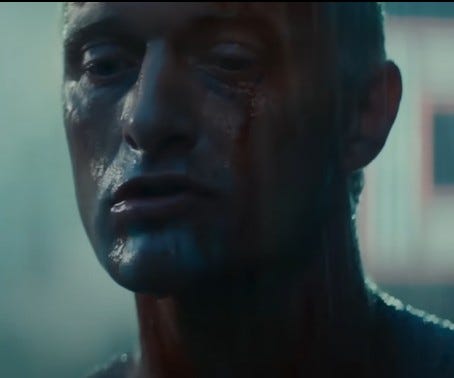
In the rain-soaked final moments of Blade Runner (1982), Roy Batty delivers his haunting monologue: "I've seen things you people wouldn't believe. Attack ships on fire off the shoulder of Orion. I watched C-beams glitter in the dark near the Tannhäuser Gate. All those moments will be lost in time, like tears in rain. Time to die." These words, improvised by Rutger Hauer, express the anguish of a finite life overflowing with wonders that will vanish entirely upon death.
This speech crystallizes a universal existential dread: the awareness that our lives, no matter how rich or adventurous, are ultimately ephemeral. Every wonder witnessed, every memory formed, will be erased when we die — lost "like tears in rain." For Roy, with his artificially brief existence, the tragedy is immediate and absolute. For ordinary humans, this same confrontation often arrives later, triggered by aging, retirement, health scares, or the quiet ticking of years, forcing a reckoning with how little time remains to gather meaningful moments before they too fade forever.
Perhaps it is this very dread that fuels the widespread phenomenon of middle-aged and senior people becoming intensely focused on travel, often through exhaustive “bucket lists.” Retirees and those approaching later life frequently compile long checklists of destinations — the Northern Lights, Machu Picchu, the Great Barrier Reef — driven by an urgent need to maximize experiences before the end. It is not always a conscious competition, yet there lingers the subtle belief that the person who sees the most places, collects the most passport stamps, or witnesses the most wonders will have "won" something against oblivion. Travel becomes a defiant response to the rain that waits to wash everything away.
Yet this fear-driven pursuit of ever more external experiences represents only one response to mortality. An alternative vision emerges from two profound statements from opposite sides of the world:
"To see a world in a grain of sand / And a heaven in a wild flower, / Hold infinity in the palm of your hand / And eternity in an hour" (from Auguries of Innocence by William Blake)
"Without leaving his house, he knows the whole universe" (from the Tao Te Ching by Lao Tzu)
Together, these ideas propose that the vastness of existence need not be chased across continents — it can be discovered in profound stillness, within the ordinary and the immediate.
In this alternative worldview, the frantic accumulation of external experiences gives way to a quieter, inward expansion. A single grain of sand, when truly seen, reveals infinite complexity and beauty under the lens of attention—just as a quiet moment at home, gazing out a window or into one's own mind, can encompass the rhythms of the entire universe. Rather than raging against the rain that will wash away every far-flung memory, this perspective finds liberation in the realization that depth, not breadth, holds the key to meaning. The elderly person who sits peacefully in contemplation, attuned to the subtle patterns of breath, light, and silence, may experience a richer eternity than the tireless wanderer who fears missing a single landmark.
Ultimately, Roy Batty's lament and the bucket-list impulse reflect one valid human cry against impermanence, while Blake and Lao Tzu offer a complementary wisdom: the universe is already present, intimate, and inexhaustible in the smallest fragment or the stillest room. Both paths honor the fragility of life—yet one races to fill the void with motion, while the other rests in the discovery that the void itself is luminous and complete. In the end, whether we travel to the edges of the earth or remain seated in quiet awareness, what endures is the quality of attention we bring to whatever time remains before the rain falls.
A wise man said, no need to roam,
The universe resides at home.
All things are one, our heart’s serene,
We’ve seen the world, though never been.
We've Seen The World